

Beekeeping 101
Everything you need to know about your AFB obligations as a beekeeper in Aotearoa New Zealand.
American Foulbrood (AFB)
American foulbrood (AFB) is a serious bacterial disease of honey bee brood caused by Paenibacillus larvae. It is one of the most significant diseases affecting honey bees worldwide. Once a colony is infected, AFB is fatal to the brood and, if left unmanaged, can spread to other colonies.
In New Zealand, AFB is managed under the American Foulbrood National Pest Management Plan (AFB NPMP), established under the Biosecurity Act. Every beekeeper has legal responsibilities to help prevent the spread of this disease.
Poor AFB management can result in significant financial losses for individual beekeepers and the wider industry, and it can also threaten New Zealand's reputation and access to valuable export markets.
NZ Bee Health & Biosecurity
NZ Bee Health & Biosecurity is a levy-funded organisation that supports beekeepers across Aotearoa New Zealand to detect, manage, and eliminate AFB.
Our team provides:
Education and training on identifying and managing AFB.
Support to help beekeepers meet their legal obligations under the AFB NPMP.
Disease surveillance and compliance activities.
HiveHub, the national database used to record apiaries, inspections, and AFB cases.
Your Responsibilities
To comply with the AFB NPMP, beekeepers must:
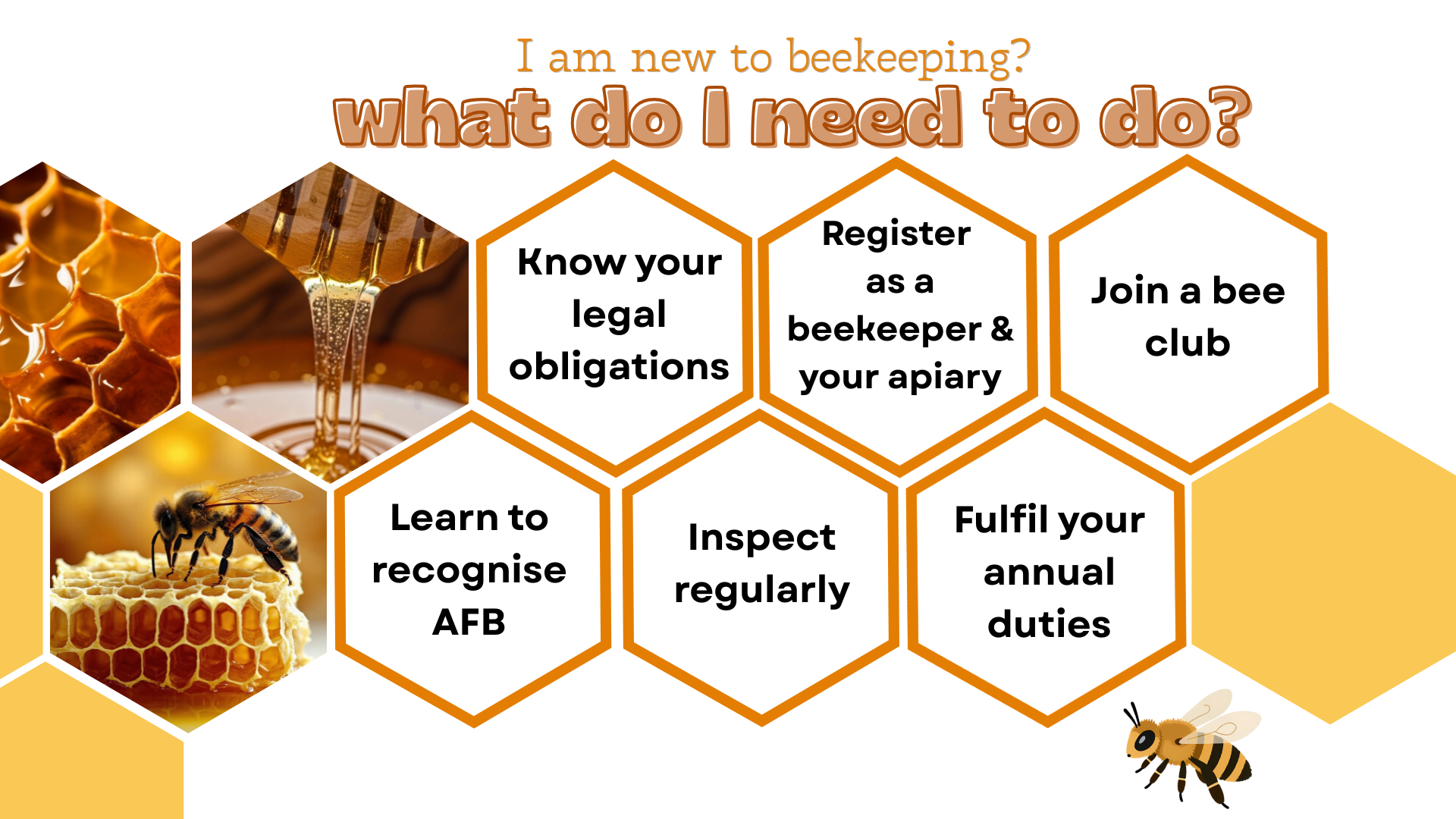
Register as a beekeeper and maintain accurate apiary records.
Regularly inspect hives for signs of AFB.
Record inspections and any AFB findings in HiveHub.
Report and destroy any colonies infected with AFB in accordance with NPMP requirements.
Complete any other obligations required under the NPMP.
This website provides step-by-step guidance to help you understand and meet these requirements.
If you need assistance, the NZ Bee Health & Biosecurity team is here to help.
Freephone: 0800 AFB PMP (0800 232 767)
Email: info@nzbb.org.nz
-
The key obligations arise from the Biosecurity (National American Foulbrood Pest Management Plan) Order 1998 (AFB NPMP)
-
If you are new to beekeeping, you must become registered. If you have not been a registered beekeeper before and currently have a hive set up on an apiary, please click the link below to start the registration process. If you need help, please contact apiary@nzbb.org.nz or phone 0800 232 767.
-
A powerful tool in the fight against AFB is education. Our training courses inform beekeepers of their legal obligations and equip them to identify AFB and eliminate it from their beekeeping operations using best practice methods.
You can find more details here.
-
Description text goes here
-
Item description
-
Item description
American Foulbrood (AFB)
American foulbrood (AFB) is a serious bacterial disease of honey bee brood caused by Paenibacillus larvae. It is one of the most significant diseases affecting honey bees worldwide. Once a colony is infected, AFB is fatal to the brood and, if left unmanaged, can spread to other colonies.
In New Zealand, AFB is managed under the American Foulbrood National Pest Management Plan (AFB NPMP), established under the Biosecurity Act. Every beekeeper has legal responsibilities to help prevent the spread of this disease.
Poor AFB management can result in significant financial losses for individual beekeepers and the wider industry, and it can also threaten New Zealand's reputation and access to valuable export markets.
NZ Bee Health & Biosecurity
NZ Bee Health & Biosecurity is a levy-funded organisation that supports beekeepers across Aotearoa New Zealand to detect, manage, and eliminate AFB.
Our team provides:
Education and training on identifying and managing AFB.
Support to help beekeepers meet their legal obligations under the AFB NPMP.
Disease surveillance and compliance activities.
HiveHub, the national database used to record apiaries, inspections, and AFB cases.
Your Responsibilities
To comply with the AFB NPMP, beekeepers must:
Register as a beekeeper and maintain accurate apiary records.
Regularly inspect hives for signs of AFB.
Record inspections and any AFB findings in HiveHub.
Report and destroy any colonies infected with AFB in accordance with NPMP requirements.
Complete any other obligations required under the NPMP.
This website provides step-by-step guidance to help you understand and meet these requirements.
If you need assistance, the NZ Bee Health & Biosecurity team is here to help.
Freephone: 0800 AFB PMP (0800 232 767)
Email: info@nzbb.org.nz
Register as a beekeeper and keep your HiveHub data up to date
If you are new to beekeeping, you must become registered. If you have not been a registered beekeeper before and currently have a hive set up on an apiary, please click the link below to start the registration process. If you need help, please contact apiary@nzbb.org.nz or phone 0800 232 767.
Register via yourself as a new beekeeper here
No longer beekeeping?
If you have no bees and wish to place your registration on hold, it is necessary to remove all hive ware from the field because abandoned hives are often found to be sources of AFB infection for neighbouring beekeepers. The form in the link below includes a declaration that you have blocked and removed all hive ware from your apiary site. Note that deregistering as a beekeeper places your registration “on hold”. Your beekeeper registration number is unique to you.
Coming back to beekeeping after taking a break from it?
If you have previously suspended your beekeeper registration but have now got bees and wish to activate your registration number again, please contact us via email apiary@nzbb.org.nz or phone 0800 232 767 so we can update your apiary information.
update
Regularly inspect your colonies for AFB
Think you have AFB? Follow these next steps east
frame_inspect
Enrol in an AFB recognition course
Enrol in an AFB recognition training course run by NZBB to ensure you understand how to identify AFB and what to do if you find it.
how_to_reg
Fulfil your annual obligations under the AFB NPMP
Complete your Annual Disease Return (ADR) on HiveHub between 1 April and 1 June. Read more about your ADR here.
Pay your annual beekeeper and colony levies between 1 April and 1 June.
Complete your Certificate of Inspection (COI) on HiveHub between 1 August and 30 November. This includes arranging a certified DECA-accredited inspector to inspect your colonies for AFB. Read more about your COI here.
task
-
Log into HiveHub. On the home screen click on 'My Apiaries' at the top of your screen.
In the "Registered Apiaries” table click the pencil icon beside the colony number you want to change (the pencil appears when you hover your cursor over the Colony number). Edit the number and then click save. -
Log into HiveHub. On the home page click on the “More” dropdown menu at the top. Select “Sales and Purchases” and add a new sale. Complete the details and save.
-
Log into HiveHub. On the home page click on the “More” dropdown menu at the top. Select “Sales and Purchases” and add a new purchase. Complete the details and save.
-
You cannot change the GPS. Please register a new apiary site and deregister the old apiary site if it does not have any beehives on it anymore.
-
Because an apiary site does not move (only the bees do), you need to register a new apiary site at your new address before deregistering the previous (now unused) apiary site at the old address.
-
Please contact an apiary coordinator by email: apiary@nzbb.org.nz or phone 0800 232 767. Provide your Beekeeper registration number and the MAF ID number of the apiary you need to update together with the reason you need to update it. We will return the apiary to you in HiveHub. You will find it ready for review under “Actions That Require My Attention” on your HiveHub home page. Click on “Review” to edit and remember to save and submit once you have moved the marker.
-
Register a new apiary at the new address before you deregister the old apiary which is no longer being used.
-
There are two ways:
1. On your HiveHub home page click on My Map, type in the address for the property your apiary is situated in. Zoom in and find the correct site. Click on the +Add Apiary button at the top right hand corner of the picture. Then click on the correct spot where your hives are located (this selects the location and populates the GPS coordinates). Click on the blue “Add apiary details” button, complete all fields and submit the apiary for processing.
2. On your HiveHub home page, click on “My Apiaries” along the top of your screen. Click on orange button marked “Register Apiaries” and follow the instructions on how to complete the form.
-
Log into HiveHub. At the top of your home screen click on “My Apiaries”. Then click on the orange “De-Register Apiaries” button.
Read the instructions on how to complete the Apiary Deregistration Form.
Scroll down and select the apiaries you wish to deregister, then click on the orange “Confirm Selection” button. If you are selecting both permanent and seasonal apiaries to delete, they will sort into two separate lists below.
Under the list of selected permanent apiaries, click on “Remove” for each apiary.
Under the list of selected seasonal apiaries, if the apiary was used for 30 days in a row, please tick the box to the left of the apiary, then click on the “Remove” button on the right.
When you have clicked “Remove” the apiary deletions will be submitted for approval by an apiary coordinator. Before approving, the apiary coordinator will check that you are not deregistering your last apiary site without completing a deregistration form.
Note that If you are deregistering all of your apiaries, you must also place your registration “on hold” by deregistering as a beekeeper. You must submit a deregistration form because it includes your biosecurity declaration that you have removed all hive ware from your apiary sites so that there is nothing left out that bees can access and potentially cause the spread of AFB.
-
First ensure all hives are blocked and taken off the apiary sites and stored away for biosecurity purposes. Then you need to place your registration on hold (deregister) by completing a deregistration form. If you have sold or given any hives away, you must ensure your beekeeper registration number has been removed from your hives and also notify NZBB who you sold or gave them to and how many. This can be done in the deregistration form, or by logging into HiveHub and recording it in sales and purchases (under the “More” drop down menu at the top of your home page) before deregistering.
You can find the deregistration form on our website home page under the “I’m leaving beekeeping“ button, or it can be accessed by clicking on the link below. Please complete all the required details and ensure the declaration that you have removed all hive ware is also ticked before clicking the submit button.
https://www.nzbb.org.nz/apiary-beekeeper-deregistration-form Once the form has been completed and submitted correctly, your deregistration can be processed and we will confirm by email.
-
First ensure the sale is recorded in your HiveHub. On the home page click on the “More” dropdown menu at the top. Select “Sales and Purchases” and add a new sale. Complete the details and save.
If you no longer own any beehives on any apiary, you need to place your registration on hold (deregister as a beekeeper) because you no longer own the bees and the apiary is now being used by another beekeeper. Please complete a Deregistration Form. You can still declare that you have no bees on any apiary because either:
1. You have requested your apiary be transferred to the new beekeeper in HiveHub; or
2. The new beekeeper will register a new apiary on your property in their HiveHub and your apiary will be deregistered because you are no longer using it.
Note: if you still own bee hives on another apiary, you must remain registered.
-
On the home page of this website in the top right corner click “HiveHub” to login. Or click here.
Your username is your email address and the password you created will have at least 8 characters, one capital letter and a number
-
Your device is linking you to the website that is open in another tab. To fix this close out any other tabs that are open.
You haven't clicked on the most recent link or an expired link. The link can only be used once and if you reset the previous link will expire. Check you are clicking on the most recent link.
Please ring us on 0800 232 767 if you require further assistance.
-
To change your email address please email apiary@nzbb.org.nz with your name and registration number, your old email address, and the new one you want to use. As this is linked to your log in, a new password reset will come to you once the request has been processed. Please ring us on 0800 232 767 if you require further assistance.
-
Your Annual Disease Return (ADR) is a prepopulated form showing all your private contact and online beekeeping records and can only be found by logging into your HiveHub account.
This form can be completed online in your Hivehub account or downloaded as a PDF.
If downloaded as a PDF, you then print and complete the form before emailing or posting back.
-
Your Certificate of Inspection (COI) is a pre-populated form showing all your personal contact and apiary details and can only be found by logging into your personal HiveHub account.
Your COI can be completed online in Hivehub or the form can be downloaded as a PDF for printing and completing before returning to us by email or post.
-
For further information on what the levy funds, please click here.
FAQs

Hivehub
HiveHub is our web-based database that allows beekeepers to edit their own contact information, report AFB, pay their levy and submit their compliance documentation Annual Disease Return (ADR), Colony Return (CR) and Certificate of Inspection (COI)). Note that apiary registrations, apiary deletions and AFB reports which are submitted via HiveHub require signing off by an Apiary Coordinator before they are accepted into the system.
login
HiveHub login
Click here to log into HiveHub online EAST
hive
HiveHub help
View our HiveHub guides and how-to videos EAST
HiveHub App
Not every apiary has cellphone coverage, so we designed the HiveHub app to store your data when you’re out of coverage. The data is stored for 24 hours, giving you time to get back to cell reception and sync any new data.
HiveHub securely stores your notifications and compliance documentation. Beekeeper privacy is a priority and we actively ensure that HiveHub meets rigorous cybersecurity standards.
On the HiveHub App you can:
Adjust colony numbers & add new apiary information
Notify cases of AFB while on the go.
Maintain compliance records while at the apiary.
Register or deregister apiaries using the easy map feature.
Report suspected non-compliance.
Accessible on most computers, tablets, and smartphones.
No internet connection is required for the HiveHub app.
Note: you cannot pay levies, submit Annual Disease Returns, Colony Returns and Certificate of Inspections using the HiveHub App. However you can log into HiveHub via the website to do these things.
Download Android app
Click here to download the app for Android EAST
task
Download iPhone app
Click here to download the app for iPhone EAST
checklist
We’re here
to help
If you are having trouble accessing HiveHub, please contact us. If you cannot complete your legal obligations on HiveHub for any reason, please select one of the below forms to complete online or contact us for paper forms.
Contact
Free Phone:
0800 232 767
Email:
info@nzbb.org.nz
POSTAL ADDRESS:
PO Box 88, Rolleston 7643
SOUTH ISLAND OFFICE:
Unit 1B, 35 Illinois Drive, Rolleston 7614
dictionary
Check out the glossary
Get to know your ADR from your COI EAST

DECA-accredited inspectors
Certified
Each year, between 1 August and 30 November, all beekeeper-managed colonies must be inspected by a certified DECA-accredited inspector as part of a beekeeper’s Certificate of Inspection (COI) obligations. It is the responsibility of the beekeeper to arrange the inspection and ensure that all administrative aspects have been completed by the inspector. These can be completed entirely on HiveHub.
Express your interest in becoming a certified DECA-accredited inspector by contacting us on 0800 232 767 or info@nzbb.org.nz
checklist
Find a DECA-accredited inspector
View a list of our certified colony inspectors EAST
Certificate of Inspection
(COI)
A COI is a legal document that must be completed by all beekeepers without a current Disease Elimination Conformity Agreement (DECA) with NZ Bee Health & Biosecurity. As per Clause 32 of the AFB NPMP, a COI is a legal document that must be completed by all beekeepers without a current Disease Elimination Conformity Agreement (DECA) with NZ Bee Health & Biosecurity.
If you are required to complete a COI, all your colonies must be inspected by a certified DECA-accredited inspector between 1 August and 30 November each year. Both the inspection and submission of your COI are submitted via HiveHub.
Every beekeeper is responsible for arranging their inspection directly with a DECA holder. You can find a list of certified DECA-accredited inspectors here.
Consult this flow chart if you are unsure whether you need to complete a COI.
-
This is a statement by an authorised person (DECA holder) confirming that they have inspected all your hives on all apiaries for American foulbrood.
-
All beehives in New Zealand are inspected by a person competent to detect American foulbrood at least once per year. This protects the sector, beekeeping operations, and neighbouring colonies from costly AFB spread and it helps to safeguard the sector’s access to important overseas markets.
-
All beekeepers who do not have a DECA with The Management Agency are required to complete a COI between 1 August and 30 November each year. Completed COI paperwork must be received by NZBB no later than 15 December.
-
Beekeepers who fail to complete a COI by 15 December are considered non-compliant. This includes those who submit a late COI after 15 December. Beekeepers who do not complete a COI at all risk being subjected to a default COI inspection by an Authorised Person (AP2). These inspections are cost recoverable as it is unfair for other beekeepers to be paying the cost of a beekeeper’s non-compliance.
-
No. Passing your AFB Recognition Course assessment does not automatically result in you obtaining a Disease Elimination Conformity Agreement (DECA) and COI exemption. You need to have completed a year of practical beekeeping and been compliant with all rules of the AFB NPMP for 12 months before you are eligible to apply for a DECA. You can learn more about obtaining a DECA here.
-
Contact a beekeeper from our list of certified DECA-accredited inspectors or a beekeeper who has held a DECA for more than one year to arrange for your colonies to be inspected. We strongly recommend that you contact a DECA holder early. You will need their first & last name, their AFB Recognition Course candidate number and their beekeeper registration number. Then log into HiveHub, click “complete COI” and request your inspection online.
For a brief video showing you this process, click the link below. Please note your declaration is at the start of the process, not the end, like the video shows.
Your apiary information then goes to the DECA holder under their own Hivehub log in. After your hives have been inspected, the DECA holder will log in to their HiveHub account and complete their record of inspection of your hives and their statement. As the beekeeper, you are responsible for ensuring that the Inspecting DECA holder has completed their statement and inspection details online and that the COI is successfully submitted to us by 15 December
If you have any trouble completing your COI on HiveHub you can download a form via HiveHub and submit that form to us instead. If you are using a form, the inspecting beekeeper must complete the Inspecting Beekeeper Statement on the front page and complete and sign the inspection details for each apiary. You then complete and sign the Beekeeper’s Statement. Beekeepers that are not on HiveHub will receive paper forms via post. Forms must be submitted within 15 days of the inspection date or before 15 December, whichever is earlier.
If you need help, contact an Apiary Coordinator at apiary@nzbb.org.nz or call 0800 AFB PMP (0800 232 767).
-
After you have completed all hive inspections for the beekeeper, log in to your own HiveHub account and under “My Inspections” complete your record of inspection, including your statement and submit the COI.
Click here for a brief video showing you this process.
If you need help, contact an Apiary Coordinator at apiary@nzbb.org.nz or call 0800 AFB PMP (0800 232 767).
-
No, you cannot inspect your own colonies to complete a COI.
-
If you have any trouble completing your COI on HiveHub you can download a form via HiveHub and submit that form to us instead. If you are using a paper form, the inspecting beekeeper must complete the Inspecting Beekeeper Statement on the front page and complete and sign the inspection details for each apiary. You then complete and sign the Beekeeper’s Statement. Beekeepers who cannot log into HiveHub can on request receive paper forms via post. As the beekeeper, you are responsible for ensuring that the Inspecting DECA holder has completed their statement and inspection details, and you are also responsible for submitting the COI. Completed COIs must be submitted within 15 days of the inspection date or before 15 December, whichever is earlier.
Click here for a brief video showing you this process.
If you need help, contact an Apiary Coordinator at apiary@nzbb.org.nz or call 0800 AFB PMP (0800 232 767).
-
All beekeepers that do not hold a DECA with NZBB are legally required to complete a COI between 1 August and 30 November each year.
-
Yes. You would need to complete a Zero Colonies Declaration.
Log into HiveHub and update your colony number to zero
Click “submit COI” then select “Submit Zero Colony COI” (this button will only appear if your colony number is showing as zero).
Or download and print a PDF copy of the form,
make a note that you have zero colonies on the form and,
return it to NZ Bee Health & Biosecurity.
If you are not sure why your colonies have died, please arrange an inspection to ensure that they are not infected with AFB.
-
A list of approved DECA beekeepers who have been a DECA holder for longer than 12 months and have volunteered to assist with the 2025 COIs can be found HERE:
Please note that the inspecting beekeeper may charge for this service. More information on the DECA accreditation process is available at www.nzbb.org.nz
Information on available DECA holders can be obtained via ApiNZ Hubs or local beekeeping clubs. -
The COI period began on 1 August 2025 and will finish on 30 November 2025. Please get your inspections done by a DECA holder and send your completed COI forms to us, within 14 days after the inspection is completed or before 15 December 2025, whichever is earlier.
-
Contact the DECA holder ahead in time to arrange for an inspection of all your hives on all apiaries.
Obtain the DECA holder’s Beekeeper Registration Number and Candidate number.
Login here and click the ‘Request Inspections’ button to request the preorganised DECA holder to inspect your beehives and submit the COI forms online, by 30 November 2025.
Please ensure inspections are completed and your online COI form is returned to us by 30 November 2025.
-
Contact the DECA holder ahead in time to plan dates for inspection to arrange for inspection of all your hives on all apiaries.
Login here and click the ‘Complete COI’ button on your HiveHub Home page.
Click on the ‘Download Paper COI’ button to download a PDF copy of your COI forms or
Once the inspection is completed, both you and the DECA holder complete the form, sign, date and return the completed form by post or email to NZ Bee Health & Biosecurity.
-
Yes, completed COIs can be uploaded via HiveHub.
Click "submit paper COI" button.
This will direct you to your email where you can attach a scanned copy of the COI form and email to apiary@nzbb.org.nz.
-
It is your responsibility as the non DECA holder to submit a completed COI. The inspecting DECA holder is only responsible to inspect the hives and record inspection findings on the form and to update any apiary information that needed to be corrected to comply with the AFB PMP.
-
Please contact an Apiary Coordinator at apiary@nzbb.org.nz or call 0800 AFB PMP (0800 232 767).
Annual Disease Return
(ADR)
An ADR is a statutory declaration as per Clause 27 of the AFB NPMP that ensures we have current and accurate information about all registered apiaries in New Zealand. All registered beekeepers must complete an ADR each year, even if they have no bees. Hives do not need to be inspected for an ADR to be submitted.
A colony return is a statutory return required for levy collection. All beekeepers are legally required to declare the number of honey bee colonies they own as of 31 March each year. (Please note that a nuc is a colony of bees.) Colony Returns are enabled in HiveHub along with ADRs and your levy invoice. If the number of colonies you have been levied for requires adjustment, we recommend providing your Colony Return as soon as possible.
This flow chart explains the process and which steps apply to you.
-
NZ Bee Health & Biosecurity administers the collection of ADRs annually. The ADR is a census of managed honey bee colonies; the official count of the number of honey bee colonies, the number of apiaries and their location, the transfer of ownership of beehives between beekeepers, and the location and date where cases of AFB were discovered.
-
The ADR provides key information about the apiaries in New Zealand and the occurrence of AFB. This information is required for us to effectively implement the AFB NPMP and make informed decisions about where resources should be applied to effectively combat the disease.
-
-
If you require a paper copy and have not received one or have mislaid your copy, please contact an Apiary Coordinator at apiary@nzbb.org.nz or by calling 0800 AFB PMP (0800 232 767).
-
View step-by-step demo videos and user guides here or request assistance via the HiveHub Help and Support tab. Alternatively, contact an Apiary Coordinator at apiary@nzbb.org.nz or by calling 0800 AFB PMP (0800 232 767).
-
NZ Bee Health & Biosecurity is committed to keeping your ADR information secure and confidential. Your privacy is important to us and data security is a priority. You can view our HiveHub Terms of Use here.
-
All beekeepers are legally required to send an ADR on or before 1 June each year.
Failure to submit an ADR is an offence under section 154N(18) of the Biosecurity Act 1993. Every person who commits an offence against section 154N (18) is liable on conviction. In the case of an individual person, imprisonment for a term not exceeding 12 months, a fine not exceeding $5,000. In the case of a corporation, a fine not exceeding $10,000.
-
You can pay your levy via credit card in HiveHub or online banking or your bank.
Direct to our bank account
New Zealand Bee Health & Biosecurity
ANZ Bank
06-0793-0901895-00You must use your beekeeper number as the reference.
Via HiveHub
Your invoice can be paid via credit card using the “pay now” button on the invoice page in HiveHub.
Any queries relating to your levies, please direct to levies@nzbb.org.nz or phone 0800 232 767.
Levy invoices generated as of 31 March are due for payment by 1 June each year.